If you’re considering TMS therapy, you’re likely looking for something that finally works, especially if medications haven’t given you the relief you expected.
But before starting, there’s one important question that deserves your full attention:
How do your current medications interact with TMS?
This is not just a technical detail. It directly affects both the safety of your treatment and how well it works.
Most people assume that TMS works independently of medications. In reality, your brain is already influenced by those medications. When TMS is introduced, it interacts with the existing environment.
That’s why a proper TMS Safety Checklist always includes a careful review of medications, lifestyle patterns, and neurological factors. When done correctly, this step does not complicate the process; it makes it safer, more predictable, and more effective.
Let’s break it down simply and practically.
Medication Interactions with TMS
TMS therapy works by stimulating specific brain circuits that regulate mood. These are the same circuits that many psychiatric medications act upon.
So when both are present, the interaction happens at the level of brain activity.
Some medications increase the brain’s excitability. In such cases, the brain becomes more responsive to stimulation, which in rare situations may slightly increase risks like seizures. This is why certain medications, such as high-dose bupropion or tramadol, are reviewed carefully before starting treatment.
On the other hand, some medications calm the brain. Drugs like benzodiazepines or certain anticonvulsants reduce neural responsiveness. This does not make TMS unsafe, but it can influence how strongly the brain responds to stimulation, which may affect how quickly you notice results.
Some medications do not significantly interfere with TMS. Many antidepressants fall into this category and are often continued throughout treatment without issue. In fact, TMS is frequently used alongside medication rather than as a replacement.
The key point is simple:
TMS does not work in isolation; it works within the environment your medications have already created.
This is why reviewing medications is a core part of TMS Safety Guidelines, followed by responsible clinics. Without this step, treatment becomes less precise and less personalized.
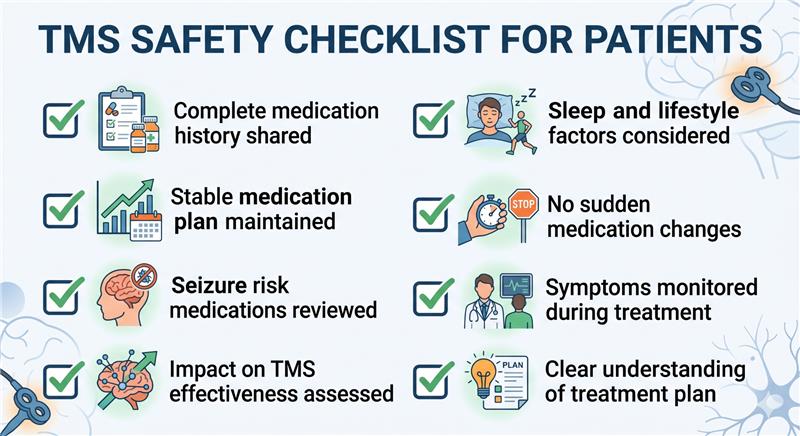
TMS Safety Checklist for Patients
A well-structured TMS Safety Checklist is not just a formality. It is the foundation of safe and effective treatment. It ensures that TMS is tailored to your individual brain, your medical history, and your current medications.
Have You Disclosed Your Complete Medication History?
The first step is complete transparency.
Before starting TMS, your clinician must know everything you are taking. This includes prescription medications, over-the-counter drugs, supplements, and herbal products.
Many patients unintentionally leave out details because they assume certain things are not important. However, even a mild sleep aid or supplement can influence brain activity. Since TMS directly affects neural circuits, these interactions matter more than you might expect.
A complete medication history allows your clinician to make an accurate safety assessment. Without it, the TMS Safety Checklist remains incomplete.
Are Your Medications Stable Before Starting TMS?
Stability plays a crucial role in both safety and effectiveness.
If medications are frequently changed before or during TMS therapy, it becomes difficult to understand how your brain is responding. Improvements, side effects, or unexpected reactions may not be clearly linked to either the medication or the stimulation.
A stable medication plan creates clarity. It allows your clinician to observe how TMS is working without interference from constant changes.
If adjustments are needed, they are usually done gradually and under supervision, not abruptly. This approach ensures that your treatment remains controlled and predictable.
Have You Been Screened for Medications That Affect Seizure Risk?
Although rare, seizure risk is one of the most important safety considerations in TMS.
Some medications can lower the brain’s seizure threshold, meaning the brain becomes slightly more sensitive to stimulation. This does not automatically make TMS unsafe, but it requires careful evaluation.
Your clinician will assess whether any of your medications fall into this category and will adjust the treatment plan accordingly if needed.
This step is a standard part of responsible TMS Safety Guidelines. It is not about excluding patients; it is about adapting treatment safely based on individual risk.
Could Any of Your Medications Reduce the Effectiveness of TMS?
Some medications have the opposite effect; they reduce how responsive the brain is to stimulation.
When this happens, TMS may still be safe, but the results may take longer to appear or feel less noticeable.
This does not always require changes in medication. In many cases, treatment continues with careful monitoring. However, understanding this interaction helps set realistic expectations and allows your clinician to make informed decisions if progress is slower.
A good TMS Safety Checklist considers not only safety but also effectiveness.
Have Lifestyle Factors Been Considered Along with Medications?
Your daily habits also influence how your brain responds to TMS.
Sleep, for example, plays a major role in regulating brain activity. Poor sleep can increase neural excitability, which may affect how stimulation is tolerated. Similarly, alcohol use, especially sudden changes, can influence neurological stability.
Caffeine intake, stress levels, and routine patterns also contribute to your brain’s overall state.
When these factors are evaluated alongside medications, your safety profile becomes more accurate. This is why a complete TMS Safety Checklist includes lifestyle assessment as well.
Do You Understand What to Avoid During Treatment?
Once treatment begins, consistency becomes essential.
Sudden medication changes, missed doses, irregular sleep, or excessive alcohol intake can disrupt the balance that has been carefully assessed before starting TMS.
Your clinician should clearly guide you on what to maintain and what to avoid. Following these recommendations helps ensure that your treatment remains aligned with safe TMS Safety Guidelines.
Are You Actively Monitoring and Reporting Changes?
TMS safety does not stop after the first session. It continues throughout the treatment process.
You play an active role in this.
If you notice anything unusual, such as unexpected discomfort, changes in mood, or neurological symptoms, you should inform your clinician immediately. Even small changes can provide valuable information.
You should also report any changes in medication, sleep patterns, or lifestyle habits. These updates help your clinician adjust treatment safely.
A strong TMS Safety Checklist is not just followed by the clinician; it is supported by the patient.
Do You Feel Informed and Confident About Your Treatment Plan?
Safety is not only clinical, but it is also about understanding.
You should feel clear about how your medications interact with TMS, what risks are relevant to you, and what to expect during treatment.
If something is unclear, you should feel comfortable asking questions.
Confidence comes from clarity. And clarity comes from open communication.
Should You Stop Medications Before Starting TMS?
Many patients assume they need to stop medications before starting TMS.
In most cases, this is not necessary.
Medications are usually continued during treatment, and any changes are made only if clinically required. These changes are done gradually and under supervision.
Stopping medication abruptly can create more risk than continuing it. It can lead to withdrawal symptoms, mood instability, or relapse.
Your treatment plan should always be guided by clinical judgment, not assumptions.
How Do Clinicians Manage Medication Safety During TMS?
Clinicians follow structured processes to ensure safe integration of medications and TMS.
This includes reviewing your full medication history, assessing potential risks, maintaining stability during treatment, and monitoring your response closely.
If needed, treatment parameters may be adjusted based on your progress and tolerance.
This is what transforms TMS from a simple procedure into a safe and personalized treatment experience.
Conclusion
Medication interactions are one of the most important and often overlooked parts of TMS therapy. The goal is not to complicate the process. It is to make it safe, personalized, and effective for you. When medications are properly reviewed and managed, TMS can work in harmony with your existing treatment rather than against it.
A thoughtful TMS Safety Checklist ensures that every step of your treatment is aligned with your individual needs.
At Mind Brain Institute, this level of careful evaluation is always the starting point, because real outcomes are built on safe and informed decisions.

Dr. Anuranjan Bist stands as a pioneering figure in the field of mental health, seamlessly blending traditional psychiatric methods with holistic wellness practices. With a profound understanding of the human mind and body, Dr. Bist has redefined therapeutic approaches by integrating Transcranial Magnetic Stimulation (TMS) and Ketamine therapy with ancient yoga techniques, showcasing his innovative spirit and dedication to comprehensive care.