You have tried antidepressant after antidepressant. You have followed every prescription, attended every therapy session, and made every lifestyle change your doctor suggested. Yet, the darkness does not lift. If this sounds familiar, you are not weak, and you are certainly not alone. You may be living with treatment-resistant depression, a condition that affects millions of people worldwide and remains one of the most challenging battles in modern psychiatry.
The good news? Science has not given up on you. In fact, one of the most exciting clinical breakthroughs in decades, esketamine for treatment-resistant depression, is changing the conversation entirely.
What Is Treatment-Resistant Depression and Why Is It So Difficult to Treat?
Treatment-resistant depression (TRD) is not simply “bad” depression. Clinically, it is defined as a major depressive disorder that fails to respond adequately to at least two different antidepressant treatments, each given at the right dose, for the right duration, in the same episode of depression.
According to the National Institute of Health (NIH), approximately 30% of people with major depression do not respond to standard antidepressant therapies. That is nearly one in three patients. These individuals experience persistent symptoms, overwhelming sadness, loss of motivation, cognitive fog, disturbed sleep, and in severe cases, suicidal ideation – despite following every conventional treatment protocol. If you or someone you love has been struggling with depression for months or years without meaningful relief, TRD could be the reason why.
What Is Esketamine and How Is It Different From Ketamine?
Esketamine and ketamine are closely related, but they are not the same thing. Understanding the distinction is important, especially if you have heard about ketamine therapy and are wondering how esketamine fits into the picture.
Esketamine is derived from ketamine, an anesthetic that has been used in medicine since the 1960s. But here is what makes esketamine special: it is the S-enantiomer of ketamine, meaning it is a specific molecular form that is approximately two to four times more potent at the brain’s key receptors than its counterpart. Think of it as the more targeted, more powerful half of the ketamine molecule.
Why Was Esketamine Developed as a Nasal Spray for Depression?
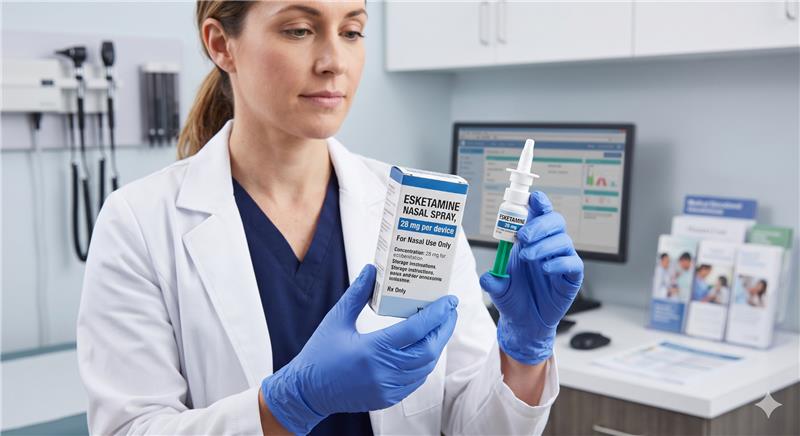
While ketamine is administered intravenously in clinical infusion settings, esketamine was developed as a nasal spray, making it far more practical, measurable, and accessible in certified clinical environments. This intranasal esketamine depression treatment delivers the medication directly through the nasal mucosa, where it is rapidly absorbed into the bloodstream and crosses the blood-brain barrier quickly. The result is a faster, more controlled therapeutic experience compared to traditional oral antidepressants.
How Does Esketamine Work in the Brain to Relieve Depression?
To understand why esketamine works so quickly, you need to understand why standard antidepressants often fall short in TRD patients.
Most conventional antidepressants are SSRIs and SNRIs, which target the serotonin or norepinephrine systems. They take four to six weeks to build up and show effect, and for TRD patients, they may never work at all. Esketamine takes a completely different route.
Esketamine is an NMDA receptor antagonist. NMDA (N-methyl-D-aspartate) receptors are part of the brain’s glutamate system, the most abundant excitatory neurotransmitter network in the brain. In people with depression, especially TRD, the glutamate system is dysregulated, leading to weakened synaptic connections in mood-regulating brain regions like the prefrontal cortex.
When esketamine blocks NMDA receptors, it triggers a rapid release of glutamate, which then activates pathways that promote synaptogenesis, the formation of new synaptic connections. In simpler terms, esketamine essentially helps the brain rebuild the neural bridges that depression has worn down. This rapid-acting antidepressant effect is precisely what makes it so clinically significant for TRD patients who are in acute distress.
What Did the FDA Approval of Esketamine Mean for Treatment-Resistant Depression?
The FDA’s decision to approve esketamine was historic, and it did not come easily. The agency granted it Breakthrough Therapy Designation, reserved for drugs that show substantial improvement over existing treatments for serious conditions.
In March 2019, the FDA approved esketamine nasal spray for adults with treatment-resistant depression, the first genuinely new mechanism of action approved for depression in over 30 years. Then, in August 2020, approval was extended for adults with major depressive disorder accompanied by acute suicidal ideation or behavior, recognising its potential to save lives in psychiatric emergencies.
Because of its potency and dissociative properties, esketamine is dispensed only through a REMS (Risk Evaluation and Mitigation Strategy) program. This means patients cannot take it home; it must be self-administered under direct medical supervision in a certified healthcare setting, followed by a two-hour monitoring period. This careful framework ensures both safety and efficacy.
What Are the Real Benefits of Esketamine for Treatment-Resistant Depression?
The clinical evidence behind esketamine for treatment-resistant depression is robust and compelling. Here are the key proven benefits:
- Rapid onset of action: Many patients experience meaningful mood improvement within hours to days, not weeks
- Effective where others have failed: Specifically designed for patients who have not responded to two or more antidepressant treatments
- Reduces suicidal ideation: FDA-approved for adults with major depressive disorder accompanied by acute suicidal ideation or behaviour
- Works synergistically: Most effective when used alongside an oral antidepressant for sustained, long-term results
- Clinically validated: Backed by multiple large-scale randomised controlled trials with statistically significant outcomes
For someone who has spent months or years waiting for relief that never came, these benefits are not just clinical data points; they represent a genuine second chance.
What Side Effects and Risks Should Patients Know About?
Esketamine is a powerful medicine, and transparency about its side effects is essential. Most side effects are temporary; they occur during or shortly after the session and resolve within the mandatory two-hour monitoring window. That said, every patient deserves a clear and honest picture before beginning treatment.
Common esketamine side effects include:
- Dissociation – a temporary feeling of detachment from reality or surroundings
- Dizziness and sedation – particularly in the first 30–60 minutes post-administration
- Nausea – mild to moderate, typically short-lived
- Altered perception – visual or sensory changes during the monitoring period
- Transient increase in blood pressure – cardiovascular monitoring is recommended during each session
More serious risks and contraindications to be aware of:
- Abuse and dependence potential, esketamine is a Schedule III controlled substance; it is never dispensed for home use
- Contraindicated in patients with a history of psychosis or schizophrenia
- Not recommended for those with aneurysmal vascular disease or hypersensitivity to ketamine
- Avoid during pregnancy and breastfeeding; safety data are insufficient
Understanding these risks does not diminish esketamine’s value; it reinforces why it must always be administered in a certified clinical setting under qualified medical supervision.
Who Is an Ideal Candidate for Esketamine Treatment?
Esketamine is considered when standard treatments have not provided enough relief and is prescribed after careful clinical evaluation.
- Adults (18+) diagnosed with major depressive disorder
- Individuals who have not responded to at least two antidepressants
- Patients with confirmed treatment-resistant depression
- Those able to attend supervised sessions at a certified clinic
- Individuals willing to follow the structured treatment schedule
- Patients who can use it alongside an oral antidepressant
- Those prepared for monitoring and follow-up care
A detailed consultation with a qualified mental health professional is essential to determine whether this treatment is the right fit for your condition.
How Does Mind Brain Institute Support Patients With Treatment-Resistant Depression?
Mind Brain Institute does not currently offer esketamine nasal spray, but it remains a leading center for evidence-based care in treatment-resistant depression. Founded by Dr. Anuranjan Bist, the institute combines psychiatry with holistic neuroscience. For patients who have not responded to conventional treatments, it offers Ketamine-Assisted Therapy, which works on similar glutamate pathways as esketamine. In addition, therapies like Transcranial Magnetic Stimulation (TMS), Neurofeedback, QEEG Brain Mapping, HRV Biofeedback, and Medical Yoga Therapy are used. This integrated approach focuses on addressing the root neurological causes of depression, offering patients a structured and personalized path toward recovery.
Overall…
Esketamine for treatment-resistant depression represents something genuinely remarkable in the history of psychiatry, a fast-acting, mechanistically different, and clinically validated option for people who have run out of conventional answers. After decades of incremental progress in antidepressant therapy, esketamine nasal spray offers a real, evidence-backed reason for hope.
But hope also lives in the hands of dedicated clinicians. Whether through esketamine or through the comprehensive, neuroscience-based therapies offered at Mind Brain Institute, one truth stands firm: treatment-resistant does not mean untreatable. The right approach, the right team, and the right timing can change everything.
If you or someone you love is living with treatment-resistant depression, do not wait. Reach out to the expert team at Mind Brain Institute and take the first step toward a personalised, compassionate treatment plan.
Medical Disclaimer: This blog is intended for informational purposes only and does not constitute medical advice, diagnosis, or treatment. Always consult a qualified psychiatrist or licensed mental health professional before making any decisions about your mental health care.

Dr. Anuranjan Bist stands as a pioneering figure in the field of mental health, seamlessly blending traditional psychiatric methods with holistic wellness practices. With a profound understanding of the human mind and body, Dr. Bist has redefined therapeutic approaches by integrating Transcranial Magnetic Stimulation (TMS) and Ketamine therapy with ancient yoga techniques, showcasing his innovative spirit and dedication to comprehensive care.