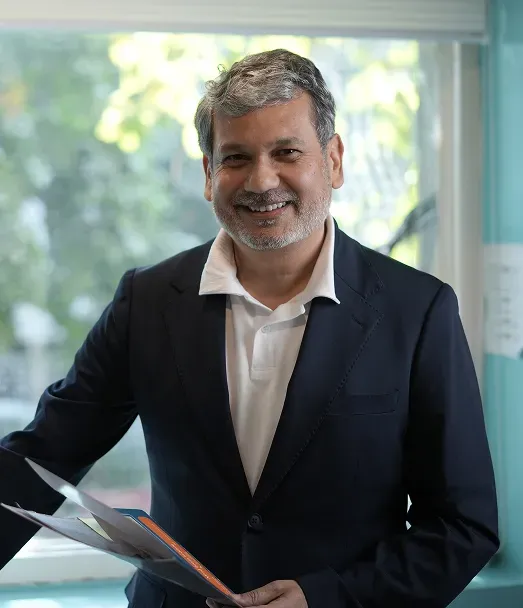
Why choose Mind Brain Institute for TMS
You’ll find TMS clinics across Delhi NCR with prices in a similar range. What you actually pay for at Mind Brain Institute is how the treatment is delivered, who delivers it, and what’s included in the price. Here’s what’s different.
1. Performing TMS since 2008 — India’s most experienced TMS practitioners Mind Brain Institute is led by Dr. Anuranjan Bist, a US Board-Certified psychiatrist trained in the USA. He has been performing TMS in the United States since 2008 — over 18 years of hands-on TMS clinical experience, a depth few clinics in India can match. This matters because TMS only works well when the stimulation is placed over precisely the right area of the brain at the correct dose. Small errors in location or intensity can be the difference between a strong response and a disappointing one. That precision comes from years of clinical practice, not from owning the machine.
2. Full range of modern TMS protocols, matched to your diagnosis Many clinics use a single house protocol for every patient. Mind Brain Institute offers the complete range: – – – – Standard rTMS — the FDA-cleared protocol for depression and OCD Deep TMS (dTMS) —New technology for treatment-resistant cases for Depression, OCD and PTSD SAINT Protocol — Stanford-derived accelerated TMS, completes treatment in 5 days ONE-D Protocol — our customised single-day TMS protocol The protocol that’s right for you is a clinical decision based on your diagnosis.
3. Transparent, all-inclusive pricing The price you’re quoted is the price you pay. Initial psychiatric assessment, treatment monitoring, protocol adjustments based on your response, and routine follow-up are all included. You’ll receive a complete cost estimate after the assessment, before treatment begins.
4. Integrated care plan, not isolated sessions A TMS session at most clinics is 30 minutes of stimulation. At Mind Brain Institute, your treatment plan can integrate TMS, ketamine-assisted therapy, neurofeedback, QEEG brain mapping, psychotherapy, and medication management — sequenced for your specific case. Book a free 15-minute consultation to discuss your case and get a transparent cost estimate.
What affects the cost of TMS therapy in India?
The price you’ll be quoted depends on five clear factors:
1. Treatment protocol. A standard rTMS course differs in length and complexity from a Deep TMS course or an accelerated SAINT/ONE-D protocol. Each is priced differently.
2. Number of sessions. A standard depression course is typically 20–30 sessions over 2-4 weeks. OCD protocols are usually 30 sessions. Treatment-resistant cases may need 36–50 sessions.
3. Brain region being targeted and technology used. Different conditions require stimulation at different sites with different coil technology.
4. Condition being treated. Depression, OCD, anxiety, and PTSD have different session counts and protocols.
5. Clinic quality and clinician expertise. This is where most hidden cost differences hide. A clinic charging ₹1,500/session may use a junior technician with minimal supervision;
the same price at Mind Brain Institute reflects 18+ years of TMS clinical experience and US-trained protocol design. Same nominal price, very different value.
Ask before booking: who designs the protocol? Who supervises sessions? How is your response monitored and adjusted? These questions reveal what you’re actually paying for.
How TMS cost in Delhi compares to other cities and countries
TMS in India costs approximately 6–12% of US pricing for equivalent FDA-cleared protocols. That's why many NRI patients now return to India specifically for TMS treatment. The international patient programme at Mind Brain Institute coordinates travel, treatment, and follow-up for patients flying in from the US, UK, UAE, and Singapore.
Is TMS therapy worth the cost?
The honest answer depends on where you are in your treatment journey. If you're early in the process and haven't yet tried first-line treatments, conventional medication and therapy may still be effective and cost-appropriate. But if you've already tried multiple medications or spent years in therapy without lasting results, the question is no longer just about cost — it becomes "what's the most effective next step for me?"
For many patients in that situation, the answer leads to TMS. Response rates in treatment-resistant depression are 50–70% in published clinical trials. When TMS works, it can significantly reduce symptoms, lower the chances of relapse, reduce the need for repeated medication changes, and help patients regain functional stability. At that point the TMS cost becomes an investment in recovery rather than another expense.
What to consider before starting TMS
A proper psychiatric evaluation answers three key questions: 1. Is TMS clinically appropriate for your condition? 2. What outcomes can realistically be expected? 3. How does TMS fit into your overall treatment plan? These considerations ensure the decision is informed, not impulsive.
The goal isn't to try every available option — the goal is to choose the one that makes the most sense for you. When searching for TMS therapy in Delhi, weigh cost against clinical quality: proper psychiatric assessment, an individualised protocol, and qualified supervision matter as much as the price. The cheapest option is not always the most cost-effective if the protocol or oversight is inadequate. TMS is most worthwhile when it's delivered correctly the first time.
Patients often ask a simple but important question: “Will this actually work for me?” The answer is not absolute, because every individual responds differently. However, TMS has shown meaningful improvement in many patients, particularly those who have not responded adequately to medications. The TMS success rate varies based on factors such as:Severity of symptomsDuration of illnessPrevious treatment historyConsistency of sessionsWhat matters more than the exact percentage is the role TMS plays. It offers an option where other treatments have not been sufficient. And that alone makes it a valuable part of modern mental health care.
FAQ
How much does TMS therapy cost in India?
At Mind Brain Institute (New Delhi), TMS therapy costs ₹1,500 to ₹3,000 per session. A full course of 20–30 sessions ranges from ₹30,000 to ₹90,000, depending on the protocol your psychiatrist recommends and your individual treatment response. The full-course figure is the most useful number to budget around, since TMS is delivered as a structured course rather than as standalone sessions.
Is TMS covered by insurance in India?
Coverage is variable. Some Indian insurers reimburse TMS for treatment-resistant depression when prescribed by a psychiatrist and supported by documented prior treatment failure. Pre-authorisation is often required. Mind Brain Institute’s team will help you verify your specific policy and prepare the documentation required to support a claim.
How many TMS sessions will I need?
A standard depression course typically involves 20–30 sessions over 4–6 weeks. OCD protocols are usually 29 sessions. Treatment-resistant depression may require 30–36 sessions. The SAINT and ONE-D accelerated protocols compress treatment into a single intensive day. Your psychiatrist will confirm the recommended course after your initial assessment.
Is TMS cheaper than long-term medication?
It depends on your situation. Medication can look cheaper month to month, but over 2–5 years the cumulative cost — including consultations, side-effect management, and the impact of relapses — can match or exceed the cost of a one-time TMS course. The most accurate comparison is one made with your treating psychiatrist based on your individual history.
What is included in the per-session price at Mind Brain Institute?
The price includes clinician supervision throughout the session, use of FDA-cleared TMS equipment, treatment monitoring and adjustments based on your response, and routine follow-up consultations within the treatment period. The initial psychiatric assessment is conducted upfront so you have a clear cost estimate before treatment begins.
Are there any hidden charges?
No. Mind Brain Institute quotes the total cost upfront after your initial assessment. Pre-treatment assessments and follow-up consultations within the treatment period are included in the package price.
Do you offer EMI or financing options?
Yes. We partner with financing providers to offer EMI plans over 6–24 months at standard interest rates. Our care coordinator will walk you through the options during your free consultation.
Why is TMS at Mind Brain Institute priced differently from other Delhi clinics?
The cost reflects 16+ years of hands-on TMS clinical experience under Dr. Anuranjan Bist (US Board-Certified, practising TMS since 2008), the availability of the full range of modern TMS protocols (rTMS, Deep TMS, SAINT, ONE-D) matched to your specific diagnosis, integrated care planning rather than standalone sessions, and 260+ verified patient reviews. Cheaper TMS exists in Delhi; comparable-quality TMS at this price does not.
How quickly can I start treatment?
Once you book your free consultation, the initial psychiatric assessment can typically be scheduled within 3–5 working days. If TMS is appropriate for you, treatment usually begins within 1–2 weeks of the assessment.
Once you book your free consultation, the initial psychiatric assessment can typically be scheduled within 3–5 working days. If TMS is appropriate for you, treatment usually begins within 1–2 weeks of the assessment.
Can I combine TMS with my current medication?
Yes. TMS is non-systemic, so it doesn’t interact with medications. Most patients continue their current medication during TMS, and many are able to reduce or discontinue medication after successful treatment, under their psychiatrist’s supervision.
Is TMS safe?
TMS is one of the safest brain stimulation treatments available — non-invasive, no anaesthesia required, no systemic side effects. The most common side effects are mild scalp discomfort and occasionally a brief headache during the first few sessions, both of which typically resolve quickly. Serious side effects are extremely rare.