Ten years ago, if a patient in India asked me where they could receive Transcranial Magnetic Stimulation for their treatment-resistant depression, I would have had a short and frustrating answer: either at one of two or three research-oriented centres in a handful of cities, or on a flight to Singapore or the United States. Today, the landscape is different. TMS Therapy in India has grown from an academic curiosity into a routinely available clinical option in several major cities, and the treatment is now transforming the lives of Indian patients in the same way it has transformed the lives of American and European patients over the past fifteen years.
But this growth raises important questions. Is TMS Therapy regulated in India the way it is in the United States? Are the clinics offering it held to any consistent standard? How does a patient in Delhi or Mumbai know whether the TMS being offered to them is legitimate? What is the appropriate role of a serious clinical centre in a market where the technology is running slightly ahead of the regulatory framework?
I want to answer these questions honestly.
What Is TMS Therapy and How Does It Work in India?
Transcranial Magnetic Stimulation is a non-invasive brain treatment that uses precisely targeted magnetic pulses to stimulate specific regions of the brain involved in depression, anxiety, OCD, and related conditions. A specialised coil is placed against the scalp, and short magnetic pulses gently activate the underlying neurons. Over a course of twenty to thirty sessions across four to six weeks, the targeted brain circuits are gradually retrained.
The mechanism is the same in India as it is anywhere else in the world. The devices approved for use in India are the same devices used in leading centres in the United States, Israel, Germany, and Australia — including systems from Neuronetics, BrainsWay, MagVenture, and Magstim. When a legitimate clinic delivers TMS in India, the technology itself is genuinely world-class.
The differences that matter lie not in the machines but in the clinicians operating them, the protocols they use, and the systems of oversight around the treatment.
Is TMS Therapy Legally Approved and Regulated in India?
Yes — but the regulatory picture is more nuanced than a simple “approved” or “not approved” answer.
TMS devices sold in India are regulated by the Central Drugs Standard Control Organisation (CDSCO) under the Medical Devices Rules, 2017. Devices used for psychiatric TMS must be registered with CDSCO to be legally sold and used. Several major international TMS device manufacturers have completed this registration and their systems are legally imported and installed at Indian clinics.
However, unlike in the United States (where the FDA regulates both the device and the specific indications for which it can be marketed), Indian regulation focuses primarily on device safety and manufacturing quality rather than on the specific psychiatric indications for which each device may be used. This means that the standards a patient should be looking for are, in practice, more about the clinic than about the device.
TMS therapy regulations in India currently rest on three pillars:
- CDSCO registration of the device
- Medical practice under a registered medical practitioner (typically a psychiatrist)
- Adherence to the international clinical protocols established by the FDA and by the Clinical TMS Society
Well-run clinics adhere to the FDA-cleared protocols even where Indian regulation does not strictly require it, because these protocols represent the current international standard of care. Poorly-run clinics may cut corners on protocol adherence, target selection, or supervision. The regulatory environment does not always distinguish clearly between these two types of practice, which is why patient education matters.
The Current Landscape of TMS Therapy Clinics in India
TMS therapy clinics in India now exist in Delhi, Mumbai, Bengaluru, Chennai, Hyderabad, Pune, Kolkata, and a growing number of smaller cities. Some are attached to academic psychiatric departments. Some are stand-alone specialty clinics. Some are units within larger hospital systems. Some, unfortunately, are Mental Health centres that have added TMS as a service without genuine psychiatric leadership.
The quality range across these clinics is unfortunately wide. A patient looking for legitimate advanced psychiatric treatment in India should evaluate potential providers against the following markers:
Senior psychiatric leadership. Every treatment plan should be created and supervised by a qualified psychiatrist, not a technician working alone. This is the most important quality marker.
Full protocol range. A legitimate TMS clinic should offer standard rTMS, theta-burst stimulation, and Deep TMS protocols. A clinic that has only one device offering one protocol is limited in what it can treat.
Transparent outcomes conversation. A clinic that promises certain relief is not being honest; a clinic that speaks in probabilities, personalises expectations to your case, and shares its actual response rates is one to trust.
Adherence to international protocols. Ask what protocols the clinic uses and how they map to the FDA-cleared standards. Legitimate clinics will answer this precisely; less serious ones will not.
Integration with psychotherapy. TMS works best when combined with therapy. A clinic that treats the coil as the whole intervention is missing half the mechanism.
Who Can Benefit from TMS Therapy in India?
TMS treatment for mental health disorders in India is most commonly used for:
- Treatment-resistant depression — the most established indication
- OCD — using the FDA-cleared Deep TMS protocol
- Anxious depression and TMS treatment for anxiety disorders more broadly
- PTSD and trauma — with growing evidence
- Bipolar depression — with appropriate protocol selection
- Smoking cessation — FDA-cleared protocol now available
- Postpartum depression and anxiety — for mothers who cannot or will not take medication
- Migraine with mood comorbidity
For each of these conditions, TMS represents a form of drug-free depression treatment and drug-free psychiatric care that avoids the systemic side effects of medication. It is not right for every patient, but it has become an important addition to the toolkit that a serious Indian clinic should offer.
Is TMS Therapy Safe and What Are the Side Effects?
TMS has one of the strongest safety records of any psychiatric treatment in active clinical use worldwide. The most common side effects are mild scalp tenderness during the first two or three sessions and, in a minority of patients, a short-lived headache after a session. These almost always resolve within the first week of treatment as the scalp adapts.
There is no sedation, no memory impact, no cognitive risk, and no dependency potential. Patients can drive themselves to and from every session and return to work the same day.
The most serious theoretical risk is a seizure, which is rare — fewer than one in thirty thousand sessions in published studies — and is essentially eliminated by careful pre-treatment screening. TMS therapy safety guidelines followed by legitimate clinics include screening for a history of epilepsy, review of medication interactions (particularly with anticonvulsants and certain psychiatric medications), and standard emergency preparedness at the treatment centre.
TMS Therapy Cost in India
This is one of the most common questions patients ask, and one of the most important reasons TMS in India matters.
A full course of TMS in India typically costs a small fraction of what the same treatment costs in the United States or the United Kingdom. This is not because Indian TMS is a lower standard of care — the devices and protocols are the same — but because the underlying cost structure of Indian healthcare is different.
TMS therapy cost in India varies by clinic, protocol, and number of sessions. At Mind Brain Institute, we deliver TMS at approximately twenty to twenty-five per cent of comparable US clinic pricing, with the same FDA-cleared protocols and senior psychiatric supervision. We do not accept insurance for TMS in India (because Indian insurers do not currently cover it), but we offer interest-free EMI options so that families can spread the cost over time.
We are transparent about pricing in the initial consultation. Patients should be cautious of clinics that will not give a clear cost figure until they have committed to treatment.
Brain Stimulation Treatment in India — Mind Brain Institute’s Role
I want to close by speaking about the role Mind Brain Institute plays in this landscape, because it is directly relevant to why I established the clinic in the first place.
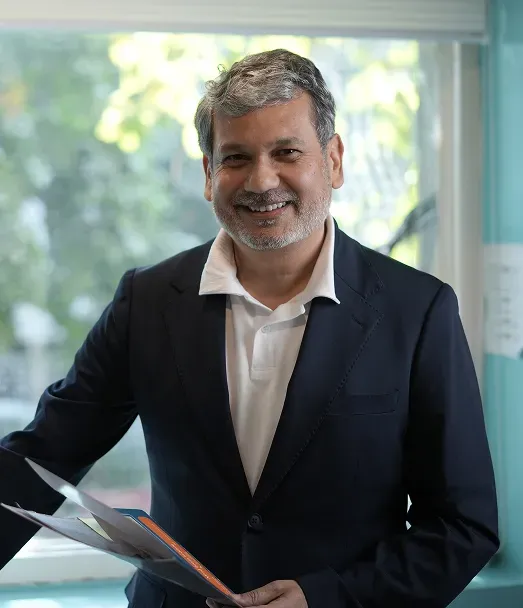
I am a US board-certified psychiatrist. I spent more than twenty years practising in the United States, delivering TMS routinely as part of my clinical practice. When I returned to India in 2021, in the aftermath of the COVID mental health crisis, I established Mind Brain Institute in Delhi specifically to bring the same international standards of TMS care to Indian patients that I had been delivering in the United States for two decades.
What that means in practice:
- Every treatment plan is created and supervised by a qualified psychiatrist, not delegated to a technician
- We offer the full range of protocols — standard rTMS, theta-burst, Deep TMS for OCD, accelerated protocols, and QEEG-guided personalisation for complex cases
- We adhere to the FDA-cleared protocols because these represent the current international standard of care
- We track and share our outcomes transparently rather than making unsupported claims
- We integrate TMS with psychotherapy because the combination outperforms either alone
- We keep our pricing accessible — twenty to twenty-five per cent of US pricing, with EMI options
If you are looking for brain stimulation treatment in India and want a clinic that operates to US-equivalent standards without US-level cost, this is the model we have built. Learn more about our TMS therapy →
FAQ
- What is TMS Therapy and how does it work in India? TMS therapy is a non-invasive, magnetic brain stimulation treatment used for depression, anxiety, OCD, and related conditions. In India, TMS devices are regulated by CDSCO, and the treatment itself is delivered at licensed medical clinics under psychiatric supervision. A standard course involves twenty to thirty sessions across four to six weeks. Most legitimate Indian TMS clinics adhere to the FDA-cleared international protocols that define the current standard of care.
- Is TMS Therapy legally approved and regulated in India? Yes. TMS devices used in India are registered with the Central Drugs Standard Control Organisation (CDSCO) under the Medical Devices Rules, 2017. The treatment itself is delivered under the supervision of a registered medical practitioner (typically a psychiatrist). The regulatory framework focuses primarily on device safety, so patients should evaluate individual clinics against clinical quality markers — senior psychiatric leadership, protocol adherence, transparent outcomes, and integration with psychotherapy.
- Who can benefit from TMS Therapy in India? Patients with treatment-resistant depression, OCD that has not responded to medication or ERP alone, anxious depression, generalised anxiety, PTSD, bipolar depression, postpartum mood disorders, and smoking cessation. TMS is also an appropriate option for patients who cannot tolerate antidepressant medication side effects, patients who prefer a non-medication approach, and pregnant patients who need to avoid systemic medication.
- Is TMS Therapy safe and does it have side effects? TMS has one of the strongest safety records in modern psychiatry. The most common side effects are mild scalp tenderness during the first few sessions and, occasionally, a brief post-session headache. There is no sedation, no memory impact, no cognitive risk, and no dependency potential. Seizure is a rare theoretical risk (fewer than one in thirty thousand sessions) and is essentially eliminated by pre-treatment screening.
- What role does Mind Brain play in providing TMS Therapy in India? Mind Brain Institute was established in 2021 by Dr. Anuranjan Bist, a US board-certified psychiatrist with 20+ years of US clinical practice, specifically to bring international-standard TMS care to Indian patients. We use the same FDA-cleared protocols and devices used in leading US centres, deliver treatment under senior psychiatric supervision, integrate TMS with psychotherapy, and price the treatment at approximately twenty to twenty-five per cent of comparable US clinic pricing. We treat patients from across India and host international patients flying in for advanced neuropsychiatric care.