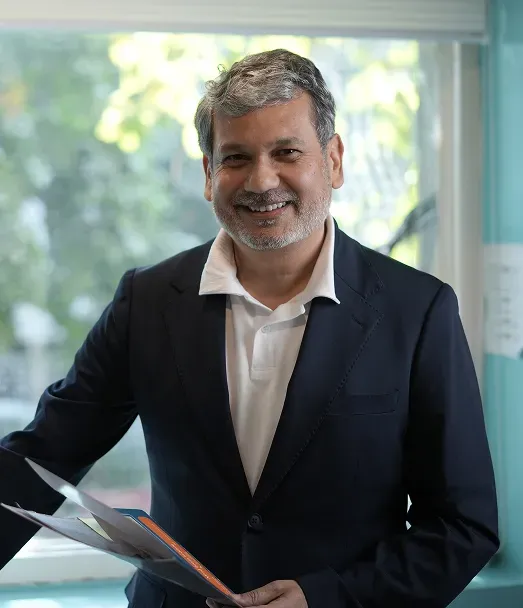
Five years ago this August, I was sitting in my clinic in the United States when I made a decision most colleagues told me I was being reckless about.
I had built what most people would call a successful career. A fifteen-year career in one of the most advanced psychiatric ecosystems in the world. I was among the first wave of psychiatrists in the country to work seriously with neuromodulation — TMS, ketamine-assisted therapy, the treatments that were quietly changing what “treatment-resistant” meant for depression. These treatment modalities were embraced with enthusiasm by patients, and soon I was running three clinics of my own.
And I was going to give it all up to move back to India.
This is the story of why — and what it’s meant for the patients we’ve been able to help since.
The call that changed the timeline
It started with a phone call from an old friend in Delhi in the middle of 2020.
He’s a doctor. He was describing what the first wave of COVID had done to his patient load — how people who had never experienced depression or anxiety in their lives were arriving at his clinic in waves. Working professionals broken by isolation. Small business owners who had watched their livelihoods evaporate. Families grieving the loss of people they hadn’t been able to say goodbye to.
He wasn’t asking me for advice. He was just describing his week.
But somewhere in that conversation, something clicked. I had spent a decade learning to deliver treatments that would help exactly the patients he was describing — the ones for whom medication alone doesn’t work, the ones stuck in what psychiatrists call the “revolving door” of failed drug trials. And those treatments were barely available in India.
I could stay in the US and read about the mental health crisis unfolding at home, or I could come home and actually do something about it.
It stopped feeling like a career decision. It started feeling like the right thing to do.
Coming back
I flew back to India in September 2020.
The next six months were spent finding a site, importing equipment (which was more complicated during a pandemic than any of us anticipated), and fitting out what would become Mind Brain Institute in Safdarjung Enclave, New Delhi.
We opened our doors in April 2021.
Roughly three weeks later, the COVID Delta wave hit New Delhi.
The decision I'm most proud of from that period
Within days of the second wave taking hold, in-person clinic visits became impossible. Delhi’s medical system was overwhelmed. Oxygen was scarce. Families were losing people they’d said goodbye to that morning.
We had to close.
The clinic stayed shut for nearly three months.
I had a small team — five or six people I had just hired weeks earlier, most of whom were themselves living through the worst period of their lives. The easiest financial decision would have been to let everyone go and reopen with a fresh team when things stabilised.
I couldn’t do it. Every person on that team had a family depending on them. Every person was scared. Firing them during a pandemic — a pandemic none of them had caused, and one that had ended a business they had trusted enough to join — would have been the easy call and the wrong one.
We kept everyone on full pay for the entire duration of the closure.
When we reopened, the same team came back. They’ve been the backbone of this clinic ever since. Every patient we’ve treated in the years that followed has been treated in part because of a decision made in the worst weeks of 2021 to not fire anyone.
That decision, more than anything else, shaped what MBI became.
What we've built since
In the four-plus years since reopening, Mind Brain Institute has treated more than 3,000 patients
- from across India, and increasingly from the United States, UK, Australia, Germany, and Southeast Asia.
We now offer the full range of advanced, evidence-based neuromodulation care I trained on in the US:
- Repetitive Transcranial Magnetic Stimulation (rTMS) for depression
- Deep TMS for OCD and severe depression
- Accelerated TMS protocols, including the Stanford SAINT protocol and one-day treatments
- Ketamine-Assisted Therapy for treatment-resistant depression and PTSD
- QEEG Brain Mapping — Mind Brain Institute is one of the few dedicated QEEG-guided treatment centres in India
- Neurofeedback and HRV Biofeedback
- Transcranial Photobiomodulation (near-infrared brain stimulation)
- Integrative modalities including medical yoga and sound healing
For a family in Delhi whose loved one has treatment-resistant depression, the earlier options were narrow: try another medication and hope, or fly abroad. A course of accelerated TMS in the US costs USD 25,000–35,000. In Singapore, comparable. Even a straightforward TMS course abroad, once travel and accommodation are added, runs into ₹15–25 lakh.
At MBI, that same care is delivered at a small fraction of overseas cost. Not because we compromise on protocol or clinical rigour — the device, the medical supervision, and the safety monitoring are the same standards I trained under in the US — but because Indian healthcare cost structures make it possible.
The gap I came home to close
Here’s what I’ve learned in five years of practicing here that I couldn’t have learned from the outside:
The gap for Indian patients isn’t clinical quality. The treatments exist. The protocols are well-defined. Any capable clinician anywhere in the world can be trained to deliver them.
The gap is access, awareness, and adoption.
Advanced neuromodulation care in India has largely remained concentrated at a handful of premier institutions — NIMHANS in Bangalore, AIIMS in Delhi. For most patients in a country of 1.4 billion, that means these treatments are functionally out of reach.
And within the psychiatric field itself, the dominant framework has for a long time been that depression is a chemical imbalance to be corrected with medication. What’s changed — and what the last decade of neuroscience has established beyond doubt — is that depression is a brain-circuit problem too. And treatments like TMS work precisely at that circuit level.
That’s not a rejection of medication. Medication remains first-line for many patients and works well for most. But for the roughly one in three patients who don’t respond fully to medication, the difference between having a second option and not having one is often the difference between recovery and years of suffering.
Bringing that option into everyday clinical practice — training psychiatrists and general physicians one-to-one, speaking at seminars and workshops, raising public awareness — is inseparable from bringing it into any single clinic.
What Independence Day means to me now
I’ve thought a lot about what Independence Day means, five years after coming home. For me, real independence isn’t political. It’s freedom from our own inner prison of anxiety, depression, and fear. No matter what a person has on the outside — success, family, resources — if they’re trapped inside that prison, none of it matters.
For too long in India, mental illness has been stigmatised and hidden. The primary treatment on offer has been medication that many patients don’t want to take for years, particularly when side effects like sedation, weight gain, and emotional blunting are difficult to live with.
Bringing advanced neuromodulation to Indian patients means offering a real path out — the chance to break the cycle, find peace, and live up to the potential nature intended.
That, to me, is what independence actually means.
That’s the independence I want to help build for my country, one patient and one trained colleague at a time.
If you or someone you love is struggling
If you’ve been on antidepressant medication for months or years without the relief you were hoping for — or if a family member is stuck in a cycle of failed treatments — please don’t lose hope. Modern psychiatry has more tools than it did even a decade ago, and many of them are now available in India.
The first step is always a proper psychiatric assessment. Response varies from person to person, and no responsible provider can guarantee a specific outcome. What we can promise is honest expectations, careful clinical attention, and a treatment plan built for your specific situation.
Learn more:
- About TMS Therapy at Mind Brain Institute
- Ketamine-Assisted Therapy
- Treatment-Resistant Depression: What Are Your Options?
- Contact Mind Brain Institute
Happy Independence Day.
FAQ
Why did Dr. Anuranjan Bist return to India from the US?
Dr. Bist returned to India in September 2020 to bring advanced neuromodulation treatments — TMS, ketamine-assisted therapy, QEEG-guided care — to Indian patients who otherwise would have needed to fly to the US, Europe, or Singapore to access them. The decision was triggered by the COVID-19 mental health crisis in India.
When did Mind Brain Institute open?
Mind Brain Institute opened in Safdarjung Enclave, New Delhi in April 2021 — three weeks before the Delta wave hit the National Capital Region.
How many patients has Mind Brain Institute treated?
Over four years since reopening, MBI has treated more than 3,000 patients from across India and internationally, including patients from the United States, UK, Australia, Germany, and Southeast Asia.
What treatments does Mind Brain Institute offer?
MBI offers the full range of advanced neuromodulation care: rTMS, Deep TMS, accelerated TMS protocols (including Stanford SAINT), Ketamine-Assisted Therapy, QEEG Brain Mapping, Neurofeedback, HRV Biofeedback, Transcranial Photobiomodulation, and integrative modalities including medical yoga and sound healing.
How much does advanced TMS therapy cost in India compared to abroad?
A course of accelerated TMS in the US costs USD 25,000–35,000 (roughly ₹22–30 lakh). In Singapore, prices are comparable. At Mind Brain Institute, similar care is available at a small fraction of that cost, without compromise on clinical protocol or safety monitoring.
Where is Mind Brain Institute located?
First Floor, Block A1, Nauroji Nagar, Safdarjung Enclave, New Delhi 110029.