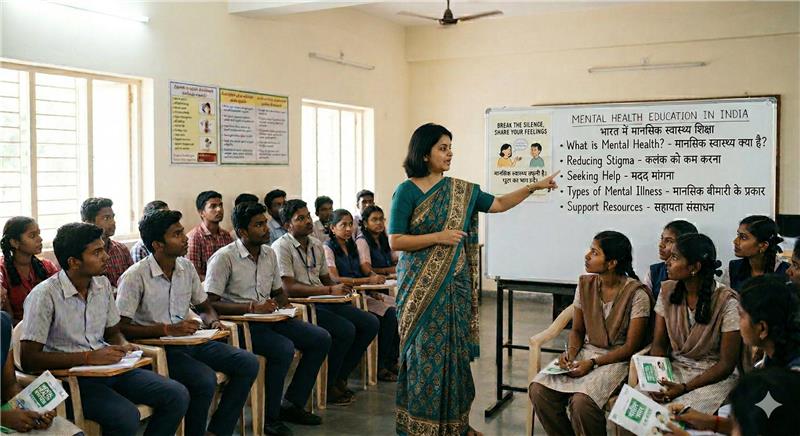
Mental health is no longer a silent issue in India. It is visible in rising stress levels, increasing cases of depression, and a growing demand for care. Yet, the foundation meant to support this demand for mental health education in India has not evolved at the same pace. Medical students are still being trained through systems that emphasize theory over lived reality. At the same time, mental health education in schools remains inconsistent, leaving young individuals without the tools to understand their own emotional health. If depression is one of the most pressing health concerns of our time, then the way we teach it must reflect that urgency.
What Is the Current State of Mental Health Education in India
Today, mental health education in India is structured but limited in depth. Psychiatry is included in medical training, yet the exposure is often brief and concentrated within a narrow timeframe. The emphasis remains on diagnostic frameworks rather than real-world interaction. This creates a gap between knowledge and application. Understanding symptoms in theory is very different from identifying them in complex, everyday presentations. Beyond medical institutions, mental health education in schools is still developing. While some progressive schools have begun introducing emotional well-being programs, there is no uniform adoption across the country. As a result, awareness varies widely depending on access and environment.
Why Is Depression Still Underdiagnosed in India

Depression in India often presents in ways that are not immediately recognized as psychological. Individuals may report fatigue, lack of energy, or physical discomfort rather than emotional distress. Without strong mental health education in India, these signals can be misinterpreted or overlooked.
The scale of the issue becomes clearer when we look at access to care. It is estimated that 70% to 92% of people in India with mental disorders do not receive proper treatment, reflecting a significant gap between need and support.
The absence of consistent mental health education in schools also plays a role. When individuals grow up without understanding mental health, they are less likely to identify symptoms or seek timely help. Broader discussions around student mental health in India continue to highlight how early awareness improves recognition and response, reinforcing the need for a more structured approach to mental health education in India.
How Does Outdated Curriculum Impact Future Psychiatrists
An outdated approach to mental health education in India affects not only knowledge but also confidence. Medical professionals may understand diagnostic criteria but feel less prepared to engage in meaningful mental health conversations. This gap becomes even more critical when viewed alongside the broader shortage of specialists. India has only 0.75 psychiatrists per 100,000 people, while the WHO recommends at least 3 per 100,000 (Garg et al., 2019).
With such limited access to specialized care, general physicians and frontline doctors often become the first point of contact for patients experiencing depression. Yet, without strong and updated mental health education in India, they may feel underprepared to handle these cases effectively.
This often leads to a narrow treatment approach. Care becomes symptom-focused rather than person-centered. The complexity of depression, especially within cultural and social contexts, is not always fully addressed. In many cases, understanding depression requires more than clinical knowledge. It demands awareness of family dynamics, societal expectations, and individual lived experiences.
Expanding mental health education in schools to include these dimensions is essential for more effective and accessible care.
Why Should Mental Health Education in Schools Start Early
Early exposure to mental health concepts changes how individuals relate to their own emotions. Mental health education in schools helps build awareness, reduces stigma, and encourages healthier coping mechanisms from a young age. When this foundation exists, it strengthens the larger ecosystem of mental health education in India. Students who understand emotional well-being are more likely to carry that awareness into adulthood, whether as patients or as future healthcare professionals. A structured approach to mental health education in schools ensures that mental health is not treated as a crisis topic but as a part of everyday life.
What Are Global Models Teaching About Mental Health Education
Globally, mental health education has moved toward integration and application. Instead of being confined to specific modules, it is incorporated across disciplines and stages of learning. Medical training in many countries includes practical exposure, simulated interactions, and continuous assessment of communication skills. Emotional intelligence is treated as an essential clinical competency. For mental health education in India, this highlights the need to shift from a purely academic approach to one that emphasizes experience and understanding.
How Can Updated Depression Curricula Transform Healthcare
Strengthening mental health education in India has the potential to significantly improve healthcare outcomes. Early identification of depression becomes more consistent, and treatment approaches become more comprehensive. Patients benefit from more accurate diagnosis and a broader range of interventions. Healthcare systems benefit from reduced long-term burden.
Ongoing discussions around the mental health care gap in India, including insights available on resources such as mental health care crisis and solutions in India, continue to emphasize the importance of systemic reform. Improved mental health education in India serves as a critical step toward closing this gap.
What Should Be Included in Modern Mental Health Education in India
A modern framework for mental health education in India should combine scientific understanding with practical training. Students need exposure to real-life case studies, patient interaction, and interdisciplinary perspectives that connect neuroscience with behavioral health. Equally important is the inclusion of communication skills. The ability to listen, interpret, and respond with empathy is central to effective mental healthcare. At the same time, strengthening mental health education in schools ensures that awareness begins early and continues to evolve through higher education.
How Can Technology Strengthen Mental Health Training
Technology provides new opportunities to enhance mental health education in India. Simulation tools, digital platforms, and telehealth systems allow for broader and more diverse learning experiences. Students can engage with case scenarios, access global research, and learn from a wider range of perspectives without geographical limitations. For mental health education in schools, technology enables scalable and interactive learning, making mental health concepts more accessible and engaging for students across different regions.
Why Are Policy Changes Critical for Mental Health Education Reform
Sustainable improvement in mental health education in India requires structured policy support. Curriculum updates must be standardized, regularly reviewed, and aligned with current clinical realities. Policy intervention is equally important for mental health education in schools, ensuring that it becomes a mandatory component of education rather than an optional initiative. Without policy-level commitment, efforts remain fragmented and inconsistent.
How Does Strong Mental Health Education Benefit Society
The benefits of improving mental health education in India extend beyond healthcare systems. A more informed population is better equipped to manage stress, seek help, and support others. When mental health education in schools is widely implemented, it contributes to a cultural shift. Mental health becomes a topic of understanding rather than stigma. Over time, this leads to healthier communities, improved productivity, and a more resilient society.
What Is the Way Forward for Mental Health Education in India
The future of mental health education in India depends on alignment across institutions, educators, and policymakers. Continuous updates to the curriculum, integration of practical learning, and early education initiatives must work together. Strengthening mental health education in schools ensures that awareness begins early, while reforms in medical training ensure that this awareness is supported by competent care. For a deeper understanding of how depression presents within the Indian context, resources like depression in the Indian context with symptoms and family care provide valuable insights. A stronger, more responsive mental health education in India is not just an academic improvement; it is a necessary step toward a healthier future.

Dr. Anuranjan Bist stands as a pioneering figure in the field of mental health, seamlessly blending traditional psychiatric methods with holistic wellness practices. With a profound understanding of the human mind and body, Dr. Bist has redefined therapeutic approaches by integrating Transcranial Magnetic Stimulation (TMS) and Ketamine therapy with ancient yoga techniques, showcasing his innovative spirit and dedication to comprehensive care.