



Treatment-Resistant Depression and The Need for Advanced Brain-Based Therapies
If you have spent months or even years trying different medications and therapies, hoping to feel better but never truly improving, you are not alone, and you are not failing. What you may be experiencing is a real medical condition, not a personal weakness. For many people, common treatments like antidepressant medications and talk therapy simply don’t bring lasting relief. It can feel like trying to start a car with a dead battery: everything looks fine, but nothing moves.
This experience is known as treatment-resistant depression. It can feel overwhelming and lonely, especially after trying so many options without success. The good news is that science is beginning to understand why this happens. Researchers now know that in some people, depression affects the brain’s functioning more deeply than chemical imbalance alone.
We are entering a new phase of mental health care – one that focuses on repairing how the brain works, not just easing symptoms. Treatments like Ketamine and TMS are offering new hope to people who once felt they had no options left.
What Is Treatment-Resistant Depression and Why Standard Care Fails
To understand treatment-resistant depression, we first have to look at how we’ve been treating mental health for the last fifty years. Since the late 1980s, the “Monoamine Hypothesis” has dominated the field. This theory suggests that depression is caused by a chemical imbalance, specifically a lack of neurotransmitters like serotonin, dopamine, or norepinephrine. This led to the development of SSRIs, which aim to keep more of these chemicals available in the brain.
However, modern research suggests this is only one piece of a much larger puzzle. While SSRIs help many, they only address the “messages” being sent between neurons; they don’t necessarily fix the “wires” themselves. If your neural circuits have become dormant or damaged due to chronic stress, increasing serotonin is like shouting into a broken telephone. It doesn’t matter how loud the message is if the line is physically down. When a patient does not respond to at least two different classes of these medications, they are clinically diagnosed with treatment-resistant depression. This failure isn’t a lack of willpower; it is a signal that the depression has deep-seated biological roots that standard pills cannot reach.
When Treatment-Resistant Depression Becomes Ultra-Refractory
As treatment-resistant depression persists, it can evolve into an even more complex state. Within the clinical spectrum of mental health, there is a deeper level of complexity known as ultra-refractory depression. This term is used when a patient has not only failed standard medications but has also seen little to no improvement from “gold standard” interventions like Electroconvulsive Therapy (ECT) or intensive, multi-year psychotherapy.
Living with ultra-refractory depression can feel like being trapped in a biological stalemate. At this stage, the brain’s “neuroplasticity,” its ability to reorganize itself and form new connections is severely diminished. Studies show that chronic, ultra-refractory depression can actually lead to the physical shrinking of the hippocampus, the area of the brain responsible for memory and emotional regulation. When the brain loses this structural flexibility, it becomes physically “locked” in a depressive state, making it nearly impossible for the person to shift their mood regardless of their external circumstances.
Why Traditional Treatment Models Fall Short in Severe Cases
Understanding this structural “lock” explains why traditional treatment models often hit a wall. One of the primary reasons is the “metabolic lag” inherent in oral medications. When you take a pill, it must pass through the digestive system and the liver before a fraction of it ever reaches the brain. By the time the active ingredients arrive, the concentration is often too low to force a significant structural change in a brain dealing with treatment-resistant depression.
Furthermore, traditional models often ignore the role of glutamate, the brain’s most abundant neurotransmitter. While SSRIs focus on serotonin, ultra-refractory depression often involves a profound dysregulation of the glutamate system, which governs synaptic plasticity. If the glutamate system is offline, the brain cannot “learn” how to be happy or calm again. This is why a person with ultra-refractory depression can be in the best therapy in the world and still feel nothing, the hardware of the brain isn’t currently capable of processing the software of the therapy. To bridge this gap, we must move beyond systemic medicine and toward targeted, brain-based interventions.
Understanding Brain-Based Therapies in Modern Psychiatry
The “Next Era of Care” is defined by this shift toward interventional psychiatry. Instead of treating the whole body in hopes of reaching the brain, these therapies treat the brain as a physical organ that requires direct stimulation or rapid-acting molecular intervention. This approach doesn’t just manage symptoms; it seeks to rebuild the neural highways that have fallen into disrepair.
For those struggling with treatment-resistant depression, this shift is revolutionary. We are no longer guessing which chemical is low; we are using technology to stimulate underactive regions or using specific molecules to trigger immediate cellular repair. This transition from “systemic” medicine to “targeted” neuromodulation is what makes recovery possible even in the most stubborn cases of ultra-refractory depression. Two therapies, in particular, have emerged as the leaders of this movement: Ketamine and Transcranial Magnetic Stimulation (TMS).
How Ketamine and TMS Therapy Work Differently Yet Complement Each Other
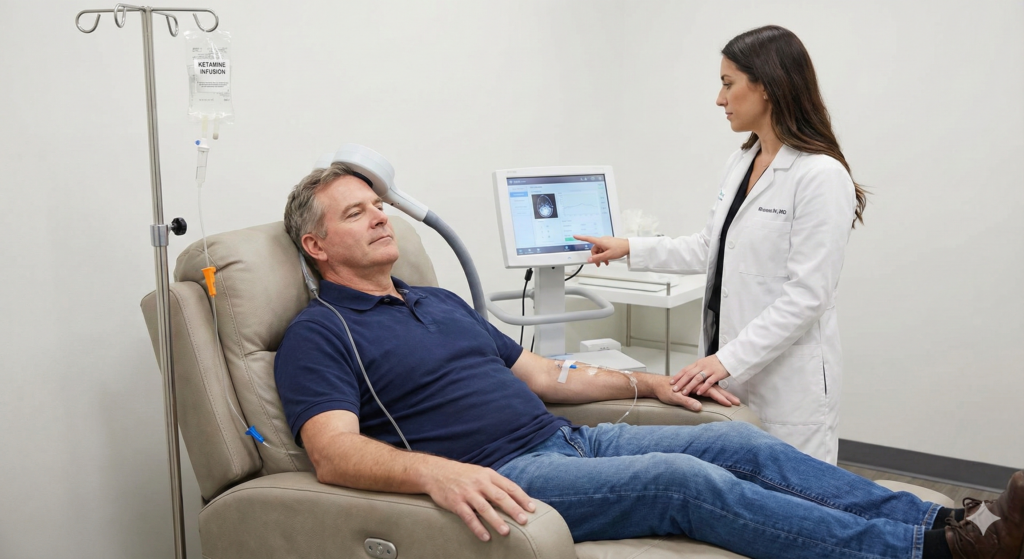
While they are both highly effective individually, Ketamine and TMS therapy work through entirely different biological mechanisms, making them a potent combination for treatment-resistant depression.
- Ketamine: Unlike traditional antidepressants, Ketamine acts on the NMDA receptors to trigger a surge of glutamate. This leads to the rapid growth of new synaptic connections, essentially acting as “brain fertilizer.” It creates a brief but intense window of neuroplasticity where the brain is suddenly able to form new pathways.
- TMS (Transcranial Magnetic Stimulation): TMS is a non-invasive procedure that uses magnetic pulses to stimulate the Dorsolateral Prefrontal Cortex (dlPFC)—the area of the brain that typically “goes dark” during treatment-resistant depression. If Ketamine is the fertilizer that prepares the soil, TMS is the “personal trainer” that repeatedly stimulates and strengthens the specific circuits that control mood.
The Mind Brain Institute has pioneered the integration of these two modalities. By combining the chemical “reset” of Ketamine-assisted therapy with the targeted electrical stimulation of Transcranial Magnetic Stimulation, we address the two main hurdles of a depressed brain: the lack of structural growth and the lack of functional activity. This dual-action protocol is designed to not only lift the fog of depression quickly but to “lock in” those improvements for the long term, offering a comprehensive solution for those who have found little success elsewhere.
Why Combining Ketamine and TMS Therapy Matters in Ultra-Refractory Depression
For a patient dealing with ultra-refractory depression, this combination is more than the sum of its parts. The logic is simple but profound: Ketamine creates the structural opportunity for change, and TMS provides the functional direction. In the past, these treatments were often siloed, but we now know that their synergy is the key to breaking through a biological stalemate.
Clinical observations suggest that when Ketamine and TMS therapy are used in tandem, the results are often more durable. The Ketamine “loosens” the rigid, depressive neural patterns, making the brain significantly more receptive to the magnetic pulses of TMS. This is particularly crucial for ultra-refractory depression, where the brain has become resistant to change. By attacking depression from both a chemical and an electrical standpoint, we maximize the chances of achieving full remission rather than just minor symptom management.
Who May Benefit Most From Ketamine and TMS Therapy
You might be wondering if your specific experience qualifies for this level of care. Generally, the ideal candidates for the combined protocol of Ketamine and TMS therapy are those who have found themselves at the end of the traditional medical road. This includes individuals who:
- Have tried three or more antidepressants without success, confirming a diagnosis of treatment-resistant depression.
- Experience “brain fog” or cognitive slowing that makes daily tasks feel impossible.
- Are looking for a non-systemic option that avoids the weight gain or sexual dysfunction often caused by pills.
- Have been diagnosed with ultra-refractory depression and felt discouraged by the results of older interventions like ECT.
If your depression feels “physical” like a heavy weight or a literal shutting down of your cognitive faculties, it is a sign that your neural circuits need the direct engagement that only brain-based therapies can provide.
The Future of Care for Treatment-Resistant Depression
The horizon for mental health is brighter than it has ever been because we are finally treating the brain with the complexity it deserves. We are moving toward “Personalized Neuromodulation,” where doctors can map your brain’s specific connectivity issues and tailor Ketamine and TMS therapy to your unique neural fingerprint.
As we continue to gather data, the stigma surrounding treatment-resistant depression is fading. It is being redefined not as a failure of will, but as a treatable biological condition. For those with ultra-refractory depression, the message is clear: the tools available today are exponentially more powerful than what was available even five years ago. We are no longer just hoping for a better day; we are building the neural architecture to make those days possible.
A New Path Forward
Treatment-resistant depression is a formidable opponent, but it is no longer an unbeatable one. By understanding that your brain might require a physical “reset” rather than just a chemical adjustment, you open the door to the next era of psychiatric care. The combination of Ketamine and TMS therapy represents the pinnacle of this movement, a way to regrow, retrain, and reclaim a life that depression tried to steal.
If you or a loved one are struggling with ultra-refractory depression, don’t settle for “good enough.” Science has moved forward, and your treatment should too. You deserve a brain that works for you, not against you.
Are you ready to explore how a personalized brain-based protocol could change your trajectory? Contact our specialists today to learn more about our integrated approach to healing.
