



Each buzz, ping, and scroll sees us into a frenzy of distraction. Technology makes us part of the world, but at times, it makes us unattached. The fact that people are bombarded with constant notifications, emails, and social feeds is one of the silent drains on mental energy and causes stress. According to one of the studies by Statista, on average, adults spend 6 hours and 38 minutes surfing the Internet every day, and this figure continues to increase annually.
With our brains constantly switched on, sleep is hard to come by, concentration is lost, and sanity is lost. That is why Digital Detox and Social Media Detox are not merely a trend in lifestyle, but they are becoming a primary practice in terms of mental health. Having a conscious screen break assists in the process of re-establishing the rhythm of the brain to allow clarity, calmness, and actual human engagement.
Why are We Addicted to Social Media?
Social media is developed based on psychology. It acts as the dopamine reward system for the brain. The reaction to every like, comment, or notification will be a small burst of dopamine, the chemical that is associated with pleasure and motivation. This leads to a cycle of obsessive-compulsive checking in the long run.
Social media sites such as Instagram apply variable reward schedules, you do not know when you will be liked; they are addictive, as is gambling. It is further complicated by the fear of missing out (FOMO), where users fear that they are not online.
Research by Frontiers in Psychology implicates that self-disclosure through social media triggers the pleasure centers in the same way as food or money. However, as much as the brain needs these micro-rewards, they tend to leave anxiety, distraction, and low self-esteem. We scroll to keep in touch and find ourselves juxtaposing our reality with the highlight reel of another person, and the boundary between interaction and emotional burnout becomes unclear.
How Can You Tell You Need a Digital Detox?
In case you touch your phone first thing in the morning and the last one before sleep, it may be time to reset. The warning signs are that you are not content without your device, spend hours scrolling without thinking, and comparing your life with those of people you see online.
The American Psychological Association revealed that more than 43 percent of adults admit to being anxious when they are not using their phones. Other effects may be the shortening of attention span, interrupted sleep, or mental exhaustion following protracted screen time. They are not habits, but pointers to early digital addiction. When online engagement begins to take the place of real life, then it is a sign that your mind is begging to be given some space.
The identification of these red flags is the initial move towards gaining control before the relationship becomes compulsive.
What Happens to Your Brain During a Digital Detox?
Your brain does not simply take a break when you disconnect, but it actually does repair. The continuous use of the screen bombards the mind with the quick dosage of dopamine, conditioning it to seek immediate satisfaction.
A Digital Detox is a good way of rebalancing that chemistry. Studies in neuroscience reveal that in the process of taking tech breaks, the prefrontal cortex – the decision-making and focusing part – gradually reacts to control. This enhances self-control and curbs one’s impulsive scrolling. This is possible due to neuroplasticity, the rewiring of the brain, which enables the brain to create new, healthier patterns whenever we purposefully restrict our exposure to the digital world.
After just a few days of low screen time, people claim to sleep better, have increased creativity, and feel stable, which is often described as emotional. Consider it as restarting your computer brain program, which is slower, muffled, but far more effective.
How to Start Your Digital Detox Journey
The most significant difference is made by taking small steps. Start by monitoring the amount of time spent on your screen each day with such apps as Digital Wellbeing or Apple Screen Time. No matter what your triggers are, social media, emails, or endless videos, etc., – turn off non-essential notifications once you know what they are.
It is possible to reclaim attention and presence by creating no-phone zones, i.e., the dining table or the bedroom.
The following is a step-by-step method to start with:
- Monitor your screen time: Learn which applications or habits are taking the bulk of your time.
- Switch off unnecessary notifications: The notifications are created in a way that they distract from concentration – disable them.
- No-phone schedule: Have a minimum of one hour each day, when you are device-free.
- Instead of scrolling, use actual activities: Reading, writing, or cooking are more fulfilling.
- Make doable objectives: It is not worth going cold turkey, but instead create consistency, not intensity.
It is not to quit technology, but to establish a healthier relationship with technology. The detox is sustainable due to progress, and not perfection.
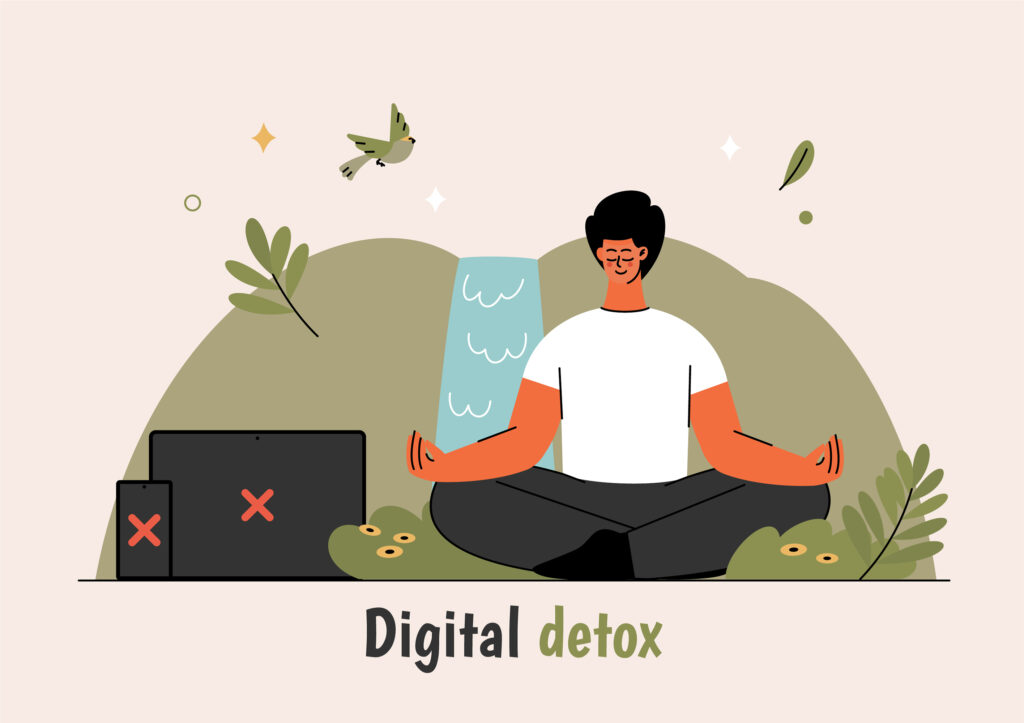
Why Should You Combine Detox with Mindful Practices?
Digital Detox is really strong when combined with mindfulness. Methods such as meditation, breathing, and journaling assist the mind in reconnecting to the present moment. Being in nature or having mindful walks will lower cortisol, the stress hormone, and improve moods. Research indicates that even a 10 minutes of meditative practice a day can be of great benefit to attention and emotional regulation.
Conscious habits that will make your digital detox:
- Deep Breathing and Meditation: Relax the mind and balance the mood swings.
- Journaling: Take notes on emotions and record the progress in the process of detoxing.
- Connection to nature: Outdoor activities enhance cognitive functions and reduce anxiety.
- Yoga or Tai Chi: These are movement-based meditations, which assist in restoring body-mind awareness.
Gradually, this mixture creates some type of resilience, anchoring you in the real world and returning to a lost human contact that technology can so easily take.
How Can Professional Therapies Support a Digital Detox?
Professional therapies may help people recover faster when they feel deep digital fatigue or anxiety caused by the screen. Evidence-based therapies, such as Neurofeedback and Transcranial Magnetic Stimulation (TMS), as well as Ketamine-Assisted Therapy (KAT), are used at the Mind Brain Institute to restore brain balance.
Neurofeedback reconditions the electrical activity of the brain to focus better, and TMS stimulates the unstimulated inactive neural pathways of attention and mood control. KAT helps to heal the emotions by improving neuroplasticity and diminishing digital overstimulation symptoms. These interventions are used to supplement a Digital Detox by treating the neurological and psychological causes of digital addiction and assisting a person in getting a sense of clarity, relaxation, and control.
What are the Long-term advantages of a digital detox?
The fruits of leaving the plug are not limited to the reduction of notifications; they change life and the mind. You will experience better sleeping, more balanced moods, focus, and relationships. A balanced digital lifestyle offers increased productivity, and stress hormones are low.
In the long run, it cultivates a sense of self, thus enabling you to lead a conscious rather than a reactive life. It is not digital rejection that is the real objective, but digital balance. You have true peace in a globalized world when technology can be used to your advantage instead of dictating your actions.
Mental balance and emotional resilience can be restored with the help of mindfulness, conscious habits, and professional assistance. When you get away from your screen, you get nearer to your mind.
Are you ready to start living a balanced digital life?
Connect with Mind Brain Institute for personalized therapies and guidance on how to heal, refocus, and reconnect – both digitally and mentally.

