




How Social Isolation, Loneliness and Mental Health are Dealt in Society
There’s a specific kind of tiredness that doesn’t come from work. It comes from feeling unseen. You can be surrounded by people, replying to messages, attending meetings, and still feel like you’re doing life alone.
That’s why loneliness and mental health has become one of the most important conversations in modern wellbeing. Not because loneliness is “dramatic,” but because it quietly changes how we think, sleep, relate, and even how safe the world feels inside our body. And when social isolation and mental health start feeding into each other, it can feel like your life is shrinking, without anyone noticing.
If this topic hits close to home, you’re not broken. You’re human. Let’s unpack what’s actually happening, and what helps.
How Are Loneliness and Mental Health Connected?
Loneliness and mental health are connected through something deeper than mood: your nervous system’s need for safety. Loneliness isn’t only about being alone. It’s the perception that your emotional needs for connection, belonging, or understanding aren’t being met.
Clinically, we often describe emotional loneliness vs social loneliness:
- Emotional loneliness: “I don’t have my person.”
- Social loneliness: “I don’t have my people.”
Both can shape the effects of loneliness on mental health, because the brain treats chronic disconnection like a long-term stress state. Over time, loneliness and mental health concerns can show up as irritability, low motivation, rumination, poor sleep, and a constant sense of “something is off.” And the hardest part? Many people become excellent at functioning while feeling empty.
If you’ve ever thought, “I shouldn’t feel this way, my life is fine,” that’s often Loneliness and mental health speaking in silence.
How Does Social Isolation Contribute to Deterioration of Mental Health?
Here’s the loop most people miss: social isolation and mental health don’t just co-exist, they reinforce each other.
When your mental health dips, you cancel plans, reply late, stop initiating, and avoid being “a burden.” That creates more distance. Then the distance deepens the low mood. Then the low mood makes you withdraw more. This is the real impact of social isolation: it changes behavior and self-belief.
Many people notice this most clearly through loneliness and depression patterns: fewer social interactions, less pleasure, more self-criticism. Others experience loneliness and anxiety: overthinking texts, fearing rejection, feeling unsafe in groups.
These are the everyday mental health effects of isolation, not always dramatic, but persistent. And yes, social isolation and mental health can worsen even if you’re technically “busy,” because busyness doesn’t equal connection.
How Brain Deals with Loneliness and How It Leads to Mental Health Decline?
If you’ve ever felt more sensitive, more defensive, or more exhausted when you’re lonely, it’s not a character flaw. It’s biology. Research shows that loneliness and social isolation increase the risk for premature death by 26% and 29%, respectively. These findings highlight that human connection is not just emotionally important but a critical factor for long-term health and survival. But let’s bring it back to daily experience. Loneliness and mental health can shift your brain into “threat scanning” mode. You start reading tone into silence. You anticipate rejection before it happens. You interpret neutral moments as evidence that you don’t matter.
This is where social isolation effects on the brain become practical: isolation can heighten stress responses, disrupt sleep, and keep the body in a state of readiness, like you’re bracing for a hit that never lands. Over time, loneliness and mental health becomes less about feelings and more about patterns in the brain-body system.
And when social isolation and mental health combine for months, people often say, “I don’t feel like myself anymore.” That sentence is a signal worth respecting.
Is Loneliness Or Social Isolation a Silent Epidemic Today?
Yes, and not because people suddenly became “weak.” Because life changed.
We’re living through a loneliness epidemic shaped by modern structure: remote work, moving cities, smaller families, longer commutes, and less community “third spaces.” Many people still carry habits of post-pandemic loneliness, even if life looks normal from the outside.
Then there’s digital loneliness, the strange ache of seeing everyone “connected” online while you feel left out in real life. Add urban loneliness, where you’re surrounded by crowds but missing warmth, and you get a perfect storm.
A 2025 WHO update on social connection highlights how loneliness and social isolation can increase risk for major health problems, and notes strong links with mental health outcomes as well.
This is why Loneliness and mental health is not a niche topic anymore. It’s a modern condition many people quietly carry.
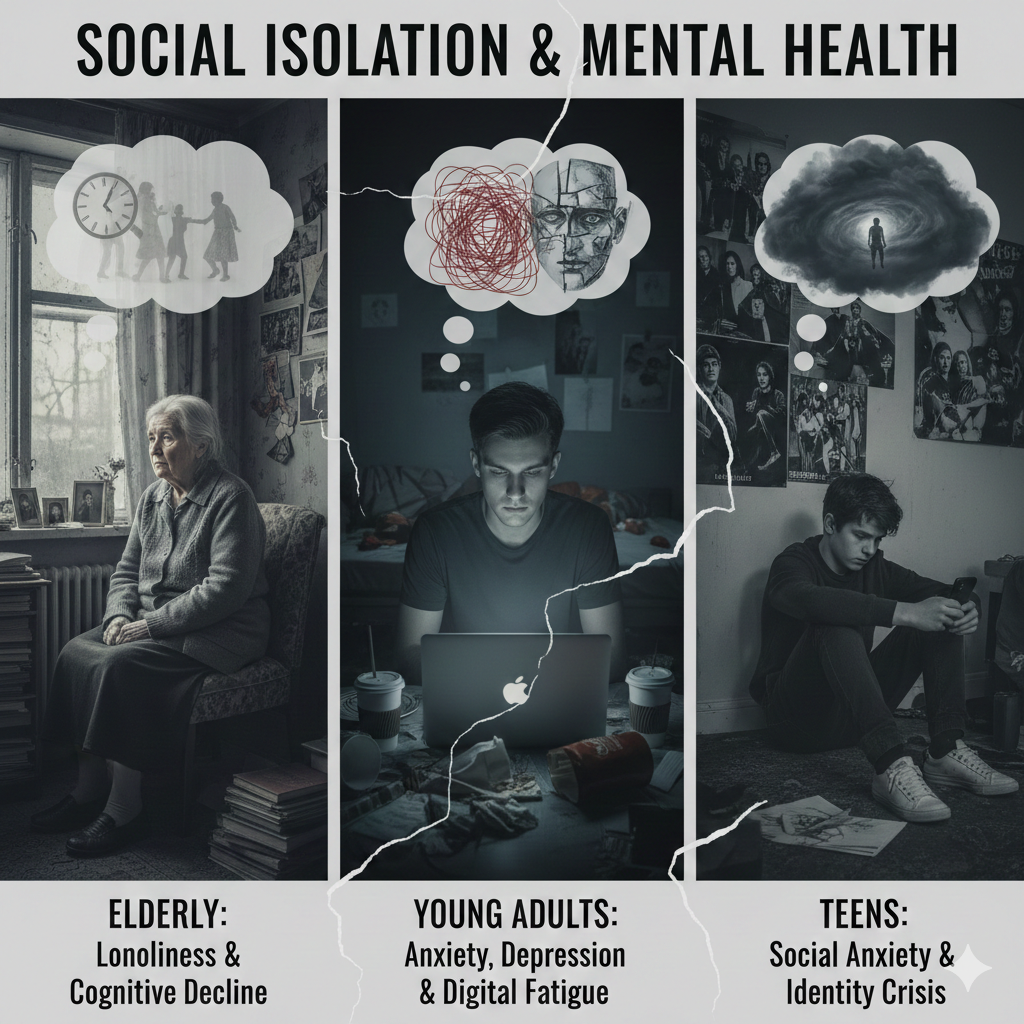
How Does Social Isolation Affect Different Age Groups?
Social isolation and mental health look different across life stages, and that matters for treatment.
For loneliness in young adults, the pain often comes from identity and belonging: “Where do I fit? Who really knows me?” This group also faces comparison pressure, unstable routines, and digital saturation, which can amplify loneliness and mental health struggles even when they seem socially active.
For loneliness in elderly individuals, isolation can be structural: retirement, loss of loved ones, health challenges, or reduced mobility. The emotional tone is often grief-like: “My world became smaller.”
In both groups, the signs of social isolation can look deceptively normal: fewer invitations, less eye contact, low energy, declining interest in hobbies, or a quiet withdrawal from conversations. But underneath, social isolation and mental health may be slowly eroding confidence and hope.
What Are the Long-Term Effects of neglecting Loneliness?
Short-term loneliness is part of being human. Chronic loneliness is different.
When people ignore loneliness and mental health for too long, the consequences can stack: persistent low mood, anxiety cycles, emotional numbness, poorer sleep, and even cognitive fog. Many people also experience chronic loneliness symptoms such as feeling disconnected even in relationships, losing trust quickly, or feeling emotionally “flat.”
If you’re wondering how loneliness affects mental health, here’s a simple way to frame it: loneliness changes the stories you tell yourself.
- “No one checks on me” becomes “I don’t matter.”
- “I’m out of the loop” becomes “I don’t belong.”
- “I don’t want to bother anyone” becomes “I shouldn’t need anyone.”
That’s why loneliness and mental health isn’t just a feeling problem, it’s a meaning problem. And when social isolation and mental health continue unchecked, people stop seeking help because they start believing help won’t work.
When Should You Seek Help for Loneliness to Deal With Mental Health Challenges?
Seek support when Loneliness and mental health starts affecting your daily functioning—sleep, appetite, concentration, motivation, or hope.
Also consider help when:
- you’re withdrawing more than you want to,
- you feel stuck in rumination,
- social isolation and mental health is becoming your “new normal,”
- or your coping methods are turning harmful (overworking, numbing, constant scrolling).
There are real loneliness treatment options, from therapy and structured community interventions to medical and neuroscience-backed care when appropriate. Support isn’t only for crises. It’s for prevention, too.
How Can Loneliness Be Addressed Effectively?
Let’s make this practical. Loneliness and mental health improves when you address both the inner system (stress, mood, sleep, self-worth) and the outer system (habits, relationships, community). Here are evidence-aligned starting points:
Name it without shaming it.
“I’m lonely” is not a weakness. It’s your brain asking for connection.
Build small, repeatable contact.
This is the core of coping with loneliness: a weekly class, a 10-minute call, a walk with one friend, a consistent community space. Connection thrives on repetition.
Practice “low-stakes honesty.”
Instead of a dramatic confession, try: “I’ve been a little withdrawn lately. Can we catch up?” That’s often the first step in dealing with social isolation.
Consider professional support when it’s persistent.
Therapy for loneliness can help you untangle the beliefs that keep you isolated (“I’m too much,” “I’m not enough”) and rebuild a safe connection.
At Mind Brain Institute, the approach is often integrative, combining psychotherapy with evidence-based, brain-focused care when needed (for example, when loneliness is tangled with depression or anxiety symptoms). And if mood symptoms are significant or treatment-resistant, Mind Brain Institute also provides clinically guided options like Transcranial Magnetic Stimulation (TMS), which targets brain circuits involved in mood regulation.
This is how Loneliness and mental health becomes treatable: not by “trying harder,” but by choosing the right supports. And when social isolation and mental health start tightening around your life, you don’t need a complete personality overhaul, you need a path back to safety, support, and meaningful connection.

